


"Ease of Closing Business" Reform of the BIR
By: Atty. Ernesto N. Dayao Jr.
"Further, the circular had finally settled that, once the taxpayer files an application and submits the complete documents as mentioned, it is no longer required to file its tax returns subsequently. The registration status of the taxpayer is updated, and its tax form types shall be set to "deregistered" in the BIR’s system. Consequently, penalties for non-filing of tax returns shall no longer accrue after submission of the requirements."
In 2024, the Ease of Paying Taxes (EOPT) Act was passed into law. In general, the law intended to facilitate the conduct of business here in the country. To this end, there were many reforms that were presented mainly to simplify the compliance obligations of taxpayers. One of these relates to the process on the cancellation of their registration in case of dissolution, as it is not a secret that closing a business in the Philippines involves a lengthy, complex, and paperwork-intensive process.
As a rule, the taxpayer needs to close its business with the local government unit and with the Bureau of Internal Revenue (BIR) office where it is registered. Thereafter, it shall proceed with its closure with the Securities and Exchange Commission (SEC). The SEC would approve the dissolution only after a certificate of tax clearance from the BIR is submitted. A tax clearance is issued only after completion of the BIR’s tax audit and payment of deficiency taxes, if any.
The EOPT Act aimed to simplify the procedures. The law, as amended by the Act, now provides that the registration with the BIR of any person or entity shall be cancelled upon mere filing, either electronically or manually. However, the law, at the same time, provided that this process shall not preclude the BIR from conducting an audit in order to determine any tax liability. The tax liability needs to be settled prior to the issuance of tax clearance for business closure.
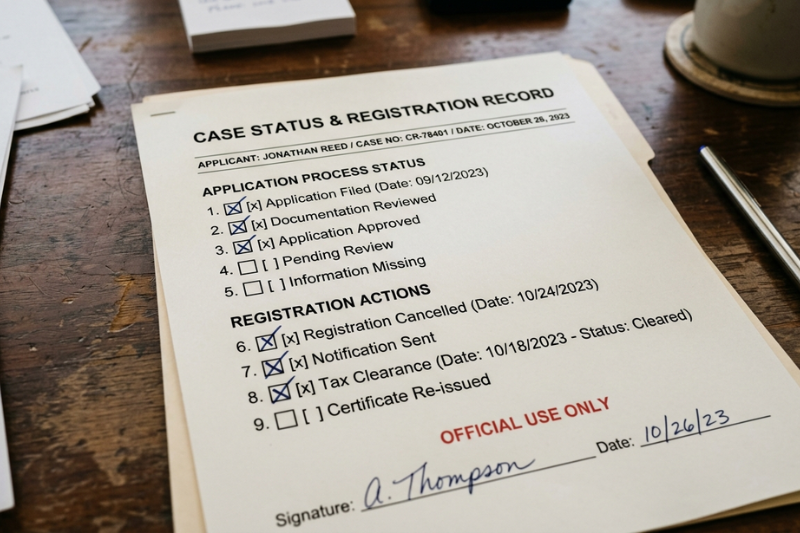
With this, there were a lot of clarifications posed. What does the provision truly mean? How did it change the previous procedures? These questions were left unanswered for a while, until our tax authority finally issued a revenue circular, RMC No. 47-2026, that clarifies the procedures and requirements in case of business closure. The RMC applies to all registered business taxpayers that have permanently ceased their operations.
Under the RMC, the following documents must be submitted in the application for closure: (a) Application Form; (b) list of ending inventory of goods and supplies, including capital goods, for VAT taxpayers; (c) unused invoices, supplementary documents and all other unutilized accounting forms; (d) original registration certificates/permits; and (e) proof of authority of the taxpayer’s representative filing the application. Note also that the circular made it clear that only these documents must be submitted for the cancellation of the taxpayer’s business registration.
Further, the circular had finally settled that, once the taxpayer files an application and submits the complete documents as mentioned, it is no longer required to file its tax returns subsequently. The registration status of the taxpayer is updated, and its tax form types shall be set to "deregistered" in the BIR’s system. Consequently, penalties for non-filing of tax returns shall no longer accrue after submission of the requirements.
Moreover, taxpayers are no longer restricted to long queues at physical tax offices as their closure applications can be submitted through both online and offline avenues. Filing can be done either manually or electronically. Electronic submission is done by sending the documents to the BIR office’s email address or through the BIR’s online registration facilities like ORUS (Online Registration and Update System) and TRRA Portal (Taxpayer Registration Related Application Portal).
Recognizing that micro enterprises (businesses with annual gross sales under ₱3,000,000) bear the heaviest administrative burden, RMC No. 47-2026 exempted them from the mandatory exhaustive tax audits during closure. In addition, if a micro taxpayer has no open cases or outstanding liabilities, the BIR will issue its tax clearance within three (3) working days from document submission. If open cases exist, the three-day period starts as soon as those liabilities are settled.
While the process is streamlined, the procedures do not dispense with the requirement of full settlement of the outstanding liabilities of taxpayers before their businesses are officially closed.
But what is important is, it is now clear that, as soon as the taxpayers close their business and apply for closure, from that moment, they are not required to file their tax returns anymore. We believe that this was the intention of our lawmakers – to relieve at once the taxpayers from their filing compliance obligations upon closure.
The article is for general information only and is not intended, nor should be construed as a substitute for tax, legal or financial advice on any specific matter. Applicability of this article to any actual or particular tax or legal issue should be supported therefore by a professional study or advice. If you have any comments or questions concerning the article, you may e-mail the author at
This email address is being protected from spambots. You need JavaScript enabled to view it. or call 8403-2001 local 340.
